The training and licensing requirements for stockbrokers vary depending on jurisdiction, and stock exchanges can also have their own requirements that are even more stringent than the minimum level set by applicable law.
Costs
Before you decide to use a stockbroker or stockbroker company, it is important that you check what it would cost you. Stockbrokers charge in various ways, including sales commissions and purchase commissions, which can be fixed or a percentage of the deal. Many stockbrokers have a minimum commission that must be paid regardless of how small the deal is.
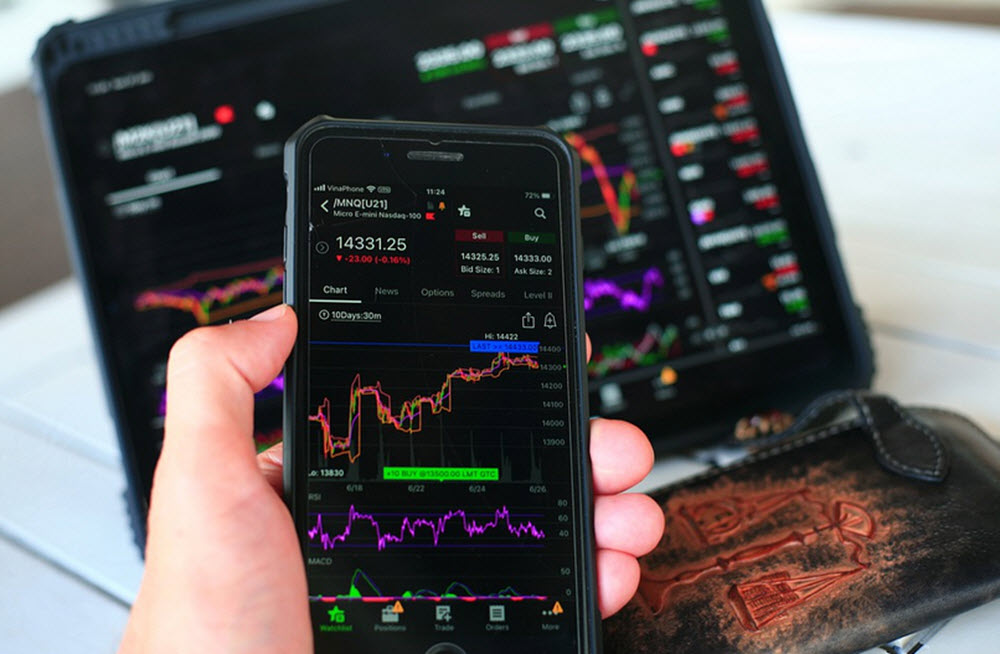
Today, small-scale investors typically use trading platforms online instead of calling their personal stockbroker to arrange a deal. This has helped bring transaction costs down, and made it possible to start investing in stocks even with a very small bankroll. Online trading platforms catering to small-scale stock buyers typically have cost schemes that are suitable for this clientèle, e.g. no large minimum commissions that would eat all the possible profits from small-scale short-term stock trading.
It is important to understand that brokerage firms, trading platforms and similar can make money on the so called ”spread”, the difference between the bid price and the ask price for a security. This is why some brokers and platforms can offer commission-free trading (under certain conditions) and still be profitable.
What is a broker-dealer?
In the financial service industry, a broker-dealer is an individual, company or other organization that engages in the businesses of trading securities for its own account or on behalf of its customers.
- The individual/organization acts as a broker when executing an order on behalf of a client.
- The individual/organization acts as a dealer when executing on order for its own account.
Some broker-dealers are independent and highly specialized, but it is also very common for broker-dealer organizations to be subsidiaries of commercial banks, investment banks or investment companies that engage in a wide range of activities alongside the broker-dealer business.
Exactly how broker-dealers are regulated and how they must handle potential conflicts of interest between themselves and their clients vary depending on jurisdiction. In the United States, one of the most important laws concerning broker-dealers is the Securities Exchange Act of 1934. Unless one of the exceptions apply, broker-dealers registered with the Securities and Exchange Commission (SEC) must also be members of the Securities Investor Protection Corporation (SIPC). The self-regulatory organization FINRA (the Financial Industry Regulatory Authority) also have substantial power within the broker-dealer industry in the United States, as authority has been delegated to them from the governmental level. In addition to this, broker-dealers must follow state law, when applicable.
Examples of large organizations that do broker-dealer business
- African Bank
- Bank of America Merrill Lynch
- Bank of New York Mellon
- Barclays
- BNP Paribas
- Citigroup
- Commerzbank AG
- Credit Suisse
- Deutsche Bank
- Goldman Sachs
- HSBC
- JPMorgan Chase
- Kepler Cheuvreux
- Morgan Stanley
- Nomura
- Societe Generale
- The Royal Bank of Scotland
- UBS
- Wells Fargo
Major Global Stock Exchanges: Market Capitalization & Profile
Key listing hubs, regional volume drivers, benchmark indices, and dominant sectors
| Exchange & Ticker Code | Region / Base | Est. Market Cap | Benchmark Index | Key Market Focus & Profile |
|---|---|---|---|---|
| New York Stock Exchange NYSE | United States | ~$28T – $30T | Dow Jones / S&P 500 | The world’s largest exchange by market capitalization; home to legacy blue-chip industrials, banking, energy, and mega-cap multinationals. |
| Nasdaq NASDAQ | United States | ~$25T – $27T | Nasdaq-100 | The global center for high-growth tech, cloud software, semiconductors, and biotechnology; electronic trading architecture. |
| Euronext EURONEXT | Pan-Europe | ~$6.5T – $7.2T | CAC 40 / AEX | Integrated cross-border European market operating unified trading books across Paris, Amsterdam, Brussels, Lisbon, Dublin, Oslo, and Milan. |
| Japan Exchange Group JPX (Tokyo) | Japan | ~$6.0T – $6.6T | Nikkei 225 / TOPIX | Asia’s premier equity market; heavy focus on industrial conglomerates, automotive manufacturers, precision electronics, and robotics. |
| Shanghai Stock Exchange SSE | China | ~$6.0T – $6.5T | SSE Composite | Mainland China’s primary exchange dominated by state-owned enterprises (SOEs), domestic financial titans, and the STAR Market tech board. |
| National Stock Exchange of India NSE | India | ~$4.5T – $5.2T | NIFTY 50 | Fastest-growing major global market; world leader in index derivatives contracts volume alongside a booming domestic retail investor base. |
| Shenzhen Stock Exchange SZSE | China | ~$3.8T – $4.3T | SZSE Component | China’s innovation and private enterprise hub, hosting high-growth tech ventures and clean energy firms via the ChiNext board. |
| Hong Kong Exchanges and Clearing HKEX | Hong Kong | ~$3.8T – $4.2T | Hang Seng (HSI) | The essential institutional gateway linking international capital with mainland Chinese listings via the cross-border Stock Connect channels. |
| London Stock Exchange Group LSEG | United Kingdom | ~$3.3T – $3.7T | FTSE 100 | A premier international cross-listing venue; features high concentrations in mining, energy, commercial banking, and pharmaceutical giants. |
| Toronto Stock Exchange TSX | Canada | ~$3.0T – $3.4T | S&P/TSX Composite | A global hub for natural resources, holding heavy weightings in mining, oil & gas production, Canadian chartered banks, and industrial utilities. |
This article was last updated on: September 14, 2026